
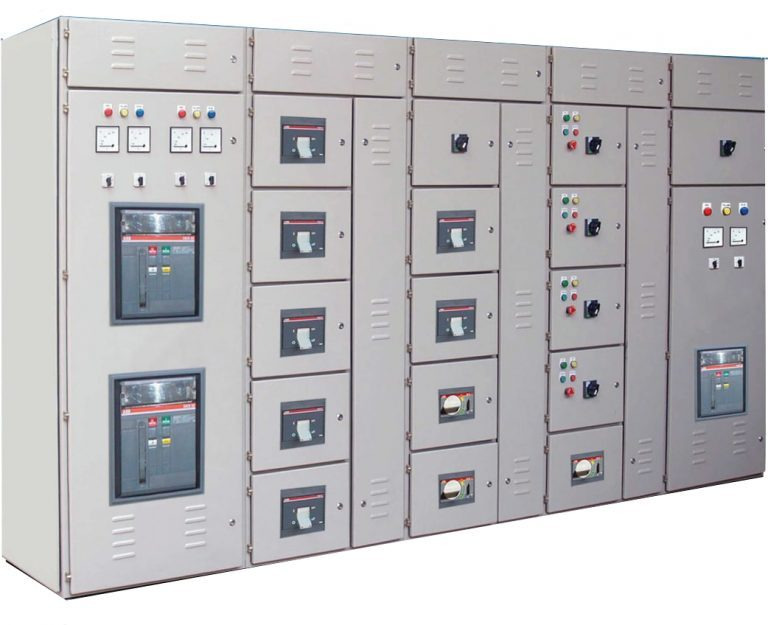
A PCC (Power Control Center) Panel is the main electrical distribution panel that receives power from a transformer or generator and distributes it to various loads such as MCC panels, APFC panels, lighting panels, and distribution boards. Main Functions Receives incoming power from the transformer or DG set. Distributes power to different feeders. Provides protection against overload, short circuit, and earth faults. Allows monitoring and control of electrical parameters. Acts as the central power distribution point in an industrial or commercial facility. Typical Technical Specifications Rated Voltage: 415 V AC, 3 Phase, 50 Hz Rated Current: 630 A to 6300 A (or higher, depending on the application) Busbar: Copper or aluminium, sized according to the current rating Short-Circuit Withstand: Typically 35–65 kA for 1 second (project-dependent) Enclosure: Floor-mounted, powder-coated CRCA steel, IP42/IP54/IP55 Form of Separation: Form 2, Form 3, or Form 4 (as required) Main Components Incomer MCCB or ACB Outgoing MCCBs/ACBs Copper or aluminium busbars Current Transformers (CTs) Potential Transformers (if required) Digital multifunction energy meter Ammeter, voltmeter, selector switches Indicating lamps (R-Y-B) Protection relays Neutral and earth busbars Typical Single-Line Arrangement Transformer / DG │ ACB/MCCB │ PCC Main Busbar ┌──────┼─────────┬─────────┐ │ │ │ │ MCC APFC DB/LDB HVAC Panel Panel Panel Panel Advantages Centralized power distribution High operational safety Easy maintenance and fault isolation Reliable protection for connected equipment Expandable for future electrical loads Applications Manufacturing plants Commercial buildings Hospitals Hotels Data centers Water treatment plants Power plants In many industrial installations, the power flow is: Transformer → PCC Panel → APFC Panel / MCC Panel / Distribution Boards → Motors, Lighting, HVAC, and other loads.


This is your website preview.
Currently it only shows your basic business info. Start adding relevant business details such as description, images and products or services to gain your customers attention by using Boost 360 android app / iOS App / web portal.
A PCC (Power Control Center) Panel is the main electrical distribution panel that receives power fro...
2026-07-31T09:30:30
A PCC (Power Control Center) Panel is the main electrical distribution panel that receives power from a transformer or generator and distributes it to various loads such as MCC panels, APFC panels, lighting panels, and distribution boards. Main Functions Receives incoming power from the transformer or DG set. Distributes power to different feeders. Provides protection against overload, short circuit, and earth faults. Allows monitoring and control of electrical parameters. Acts as the central power distribution point in an industrial or commercial facility. Typical Technical Specifications Rated Voltage: 415 V AC, 3 Phase, 50 Hz Rated Current: 630 A to 6300 A (or higher, depending on the application) Busbar: Copper or aluminium, sized according to the current rating Short-Circuit Withstand: Typically 35–65 kA for 1 second (project-dependent) Enclosure: Floor-mounted, powder-coated CRCA steel, IP42/IP54/IP55 Form of Separation: Form 2, Form 3, or Form 4 (as required) Main Components Incomer MCCB or ACB Outgoing MCCBs/ACBs Copper or aluminium busbars Current Transformers (CTs) Potential Transformers (if required) Digital multifunction energy meter Ammeter, voltmeter, selector switches Indicating lamps (R-Y-B) Protection relays Neutral and earth busbars Typical Single-Line Arrangement Transformer / DG │ ACB/MCCB │ PCC Main Busbar ┌──────┼─────────┬─────────┐ │ │ │ │ MCC APFC DB/LDB HVAC Panel Panel Panel Panel Advantages Centralized power distribution High operational safety Easy maintenance and fault isolation Reliable protection for connected equipment Expandable for future electrical loads Applications Manufacturing plants Commercial buildings Hospitals Hotels Data centers Water treatment plants Power plants In many industrial installations, the power flow is: Transformer → PCC Panel → APFC Panel / MCC Panel / Distribution Boards → Motors, Lighting, HVAC, and other loads.
2026-07-31T09:30:30


 Panel is th)

Submit Your Enquiry